How do you choose the right geographic farm area as a real estate agent — and what makes one farm actually work while another one quietly drains your marketing budget?
Most advice on this topic starts with the numbers: turnover rate, home count, agent saturation. And yes, those things matter. But they're not what separates the agents who build real market dominance from the ones who send postcards for eight months and quit.
Here's the part most guides skip entirely.
The Data Is the Starting Point, Not the Answer
Before anything else, yes — pull the numbers. Look at how many homes are in the area and how many sold in the last 12 months. A turnover rate above 6% is generally worth considering; above 8% is solid. Look at who's already farming there. If one agent has handled 30% of the sales in a neighborhood for the past three years, that's their territory and breaking in will take significantly longer.
A manageable starting size for most agents is 300 to 500 homes — large enough to generate real opportunity, small enough to market to consistently without burning through your budget in 90 days.
In Northeast Florida, this analysis looks a little different depending on where you're looking. Growing communities in St. Johns County — Durbin Crossing, Aberdeen, Beachwalk, Shearwater — tend to have strong turnover driven by move-up buyers and relocations. Nocatee, one of the largest master-planned communities in the country, has its own distinct market dynamics. Established neighborhoods in Mandarin, Fleming Island, or Orange Park move differently than fast-growing pockets near Green Cove Springs or Middleburg. Know the market you're evaluating, not just the concept of geographic farming in general.
The Question Nobody Asks: Can You Actually Show Up There?
Here's what most agents skip — and it's the thing that predicts whether a farm succeeds more than any spreadsheet will.
Do you have a genuine reason to be in this community?
Not "I want to list homes here." A real reason. Do you shop there, eat there, work out there, have kids in activities there? Is it close enough to your home or office that you'll naturally pass through it? Could you join a community Facebook group and actually contribute something useful — not just drop listings?
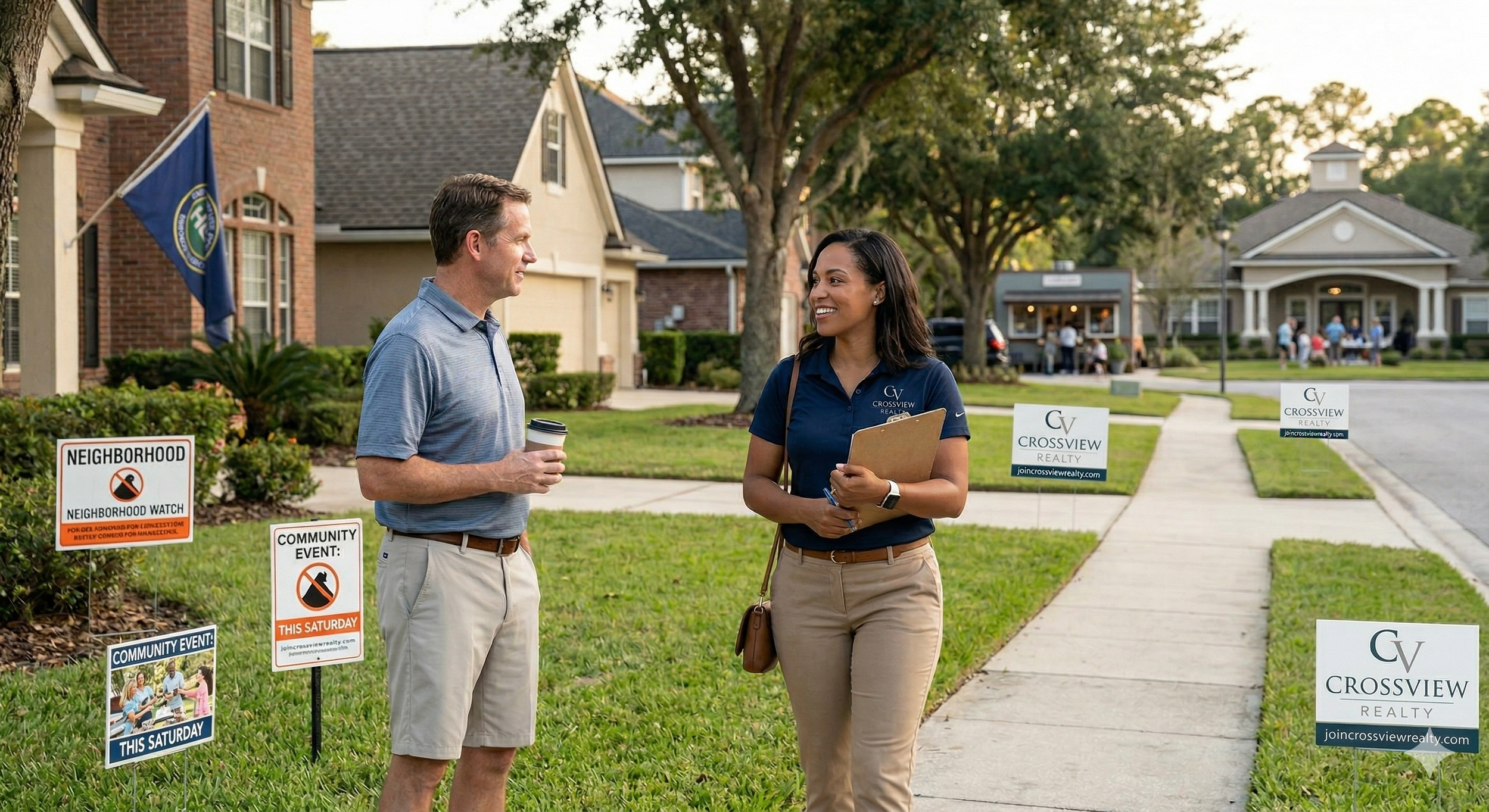
The farms that produce results aren't just receiving your postcards every month. They're seeing your name at the community HOA meeting, in the neighborhood Facebook group, at the local coffee shop. They're recognizing your face before they ever pick up the phone.
The farm you're actually connected to will always outperform the farm that looks perfect on paper. Because the numbers can support a decision, but they can't sustain the consistency. Only genuine engagement does that.
Northeast Florida Has a Built-In Farming Advantage Most Agents Ignore
This is specific to our market and worth paying attention to.
Many of the communities across NE Florida — especially the master-planned developments in St. Johns County and the Nocatee community in Ponte Vedra — have highly active online community groups, neighborhood apps, HOA newsletters, and local Facebook pages with thousands of members. These aren't passive audiences. These are residents who are actively engaged, sharing recommendations, asking for referrals, and talking about everything from contractor recommendations to which houses just sold on their street.
An agent who becomes a genuine, helpful presence in those digital spaces — answering questions, sharing real market data, contributing to community conversations without making everything about real estate — is doing more to establish themselves as the neighborhood expert than a year of monthly mailers.
This doesn't replace the postcards. It multiplies them. When someone gets your mailer and they've already seen your name in the community Facebook group three times that month, the name recognition is already there. The mailer becomes a confirmation, not an introduction.
The Farm You Shouldn't Pick
One more thing most guides won't say directly: don't pick your farm based purely on the price point you want to work.
A lot of agents look at luxury communities in Ponte Vedra Beach or the Intracoastal corridor and think — I want to list those homes. And that's a reasonable goal. But if you have no personal connection to those communities, you're competing against agents who have been embedded there for years, whose names are known at every neighborhood gathering, who have built genuine relationships with homeowners over time. Walking in with a postcard campaign isn't going to break that.
Pick a farm where you can win — where you can be present, where the numbers support opportunity, and where you can sustain the effort long enough for it to pay off. Then expand from a position of strength.
As we've talked about with sphere of influence and lead generation — volume isn't the strategy. Consistency in the right place is. That same principle applies here. It's the same idea we covered in our post on when more leads isn't the real problem.
How CrossView Realty Approaches This
At CrossView Realty, we help agents think through their geographic strategy as part of building a real business plan — not just a marketing checklist. If you're an agent in Jacksonville, St. Augustine, or anywhere across Northeast Florida who wants to talk through where farming might fit into your business, we'd love that conversation. Reach out at joincrossviewrealty.com or call 904-503-0672.
The right farm isn't just a neighborhood with good numbers. It's a community you're genuinely willing to show up in — month after month, before the leads come — because you believe in the long game. Pick the one you'll actually work, and then work it like you mean it.
Frequently Asked Questions
Q: How do you choose a geographic farm area in real estate? Start with the data — look for a turnover rate above 6%, a manageable home count of 300 to 500 homes, and relatively low agent saturation. Then ask the more important question: do you have a genuine reason to be present in this community? The best farm on paper is worthless if you won't consistently show up in it.
Q: How many homes should be in a real estate farm area? Most agents starting out do well with 300 to 500 homes. It's enough to generate real listing opportunity over time without requiring a marketing budget that's unsustainable in year one. Once you've established strong name recognition in a smaller area, expand.
Q: How long does geographic farming take to produce results in real estate? Most agents should expect 6 to 12 months of consistent effort before seeing meaningful results. Farming is a long-game strategy — the agents who succeed are the ones who maintain consistent touches and community presence even when the early months feel quiet.
Q: What makes a good geographic farm area in Northeast Florida? NE Florida's growing communities — particularly in St. Johns County, Nocatee, and expanding areas like Green Cove Springs and Middleburg — offer strong turnover and less established competition than some older Jacksonville submarkets. Master-planned communities with active online groups and HOA engagement also give agents an additional layer of visibility beyond traditional direct mail.
Q: Should I farm the neighborhood I live in? Living in your farm is an advantage because it gives you a natural reason to be present. But don't choose it by default — verify the numbers first. If your neighborhood has a low turnover rate or is already dominated by a well-established agent, an adjacent community with better metrics may be the smarter starting point.