How to Work Your Real Estate Geographic Farm Consistently
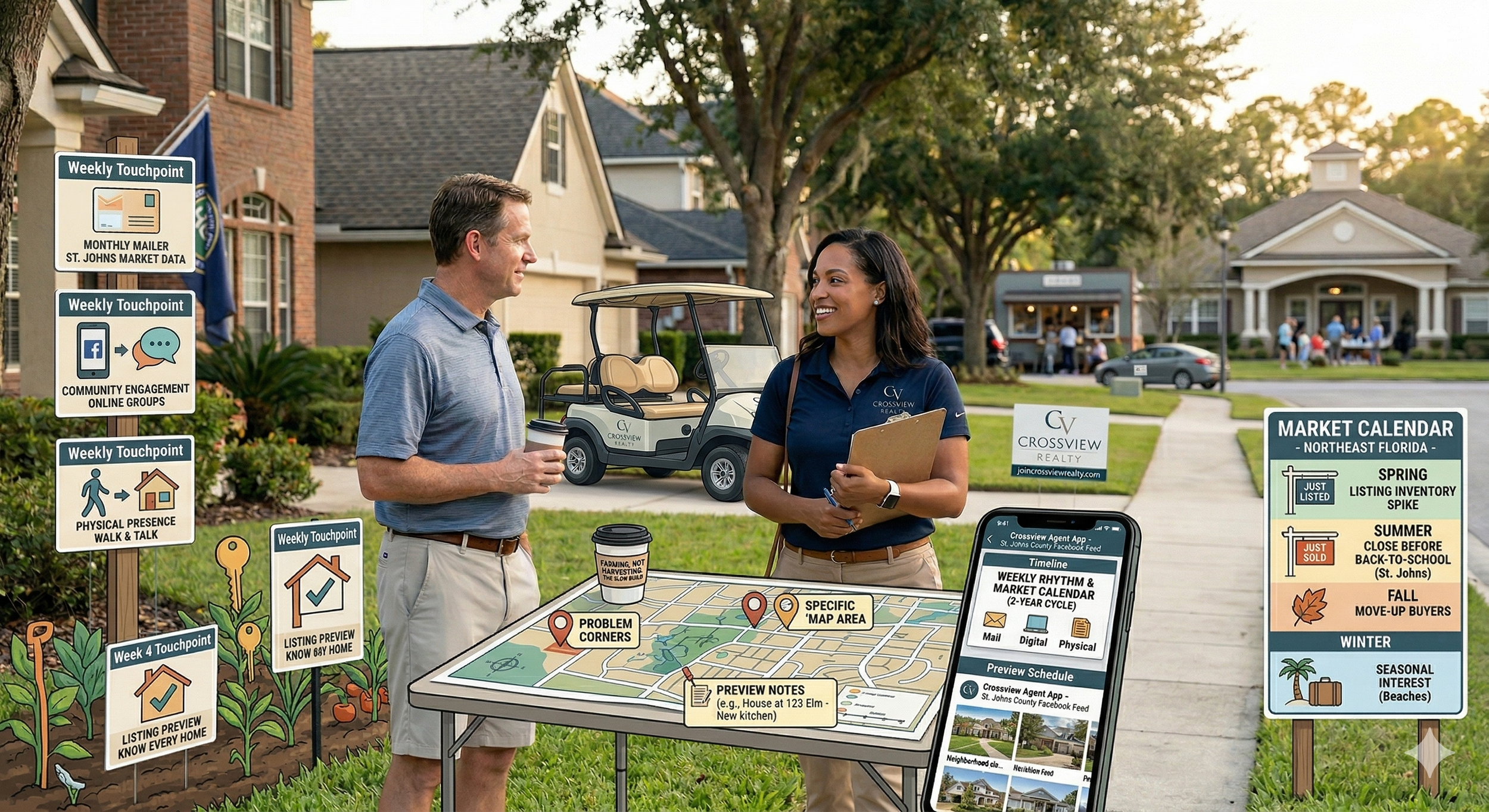
Once you've chosen your geographic farm, how do you actually work it in a way that builds real market dominance — without burning out or going quiet after a few months?
Most agents who try farming do the same thing: they send a few postcards, wait for calls that don't come, and quietly stop. Then they tell themselves farming doesn't work.
It works. They just didn't work it long enough — or the right way. Here's the system that actually holds.
Understand the Difference Between Farming and Harvesting
This is the mindset shift that changes everything.
Farming is the slow, invisible work of building name recognition, trust, and community presence before anyone is ready to call you. Harvesting is when the calls start coming in — when a homeowner sees your name on their third Just Sold card, remembers you from the neighborhood Facebook group, and picks up the phone.
Most agents quit during the farming phase because they mistake the absence of harvest for proof that the strategy isn't working. It is working. It's just underground.
Commit to the farm like it's a two-year decision, not a two-month experiment. The agents who own their neighborhoods didn't get there in a quarter. They got there because they were still showing up when everyone else stopped.
Build a Weekly Rhythm, Not Just a Monthly Mailer
The postcard matters. Send it every month without fail — same neighborhood, consistent branding, real market data. That's your baseline. But the agents who break through aren't doing one thing a month. They're doing small, consistent things every week.
Here's a simple weekly framework:
Mail: One monthly touchpoint to every home in your farm. Just Listed and Just Sold cards whenever you have them — these are your most powerful proof-of-presence tools. Don't treat them as bragging. Treat them as evidence that you're the agent who gets results here.
Digital: Spend a few minutes each week in the community Facebook group or Nextdoor for your farm area. Answer questions. Share a market update. Comment on something that has nothing to do with real estate. In the master-planned communities across NE Florida — Nocatee, Shearwater, Beachwalk, communities throughout St. Johns County — these online spaces are where neighbors talk. Be a neighbor, not a billboard.
Physical presence: Drive your farm regularly. Walk it when you can. Stop and talk to someone working in their yard. Know the streets, the problem corners, the houses that need attention. This is the kind of knowledge that comes out naturally in listing appointments and sets you apart from every agent who's only ever seen the neighborhood on a map.
Preview listings: Every single home that comes on the market in your farm — try to get inside it. Schedule a showing. Attend the open house. Take notes. After 12 months of doing this consistently, you can walk into a listing appointment and say you've personally been inside the majority of homes that have sold in this neighborhood. That's not a marketing claim. That's credibility that nobody can fake.
Let the Seasons Work For You in Northeast Florida
NE Florida has its own market calendar, and your farm strategy should move with it.
Spring activates listing inventory across most of the market — it's your highest-volume window for Just Listed and Just Sold activity. Back-to-school season in St. Johns County drives a predictable wave of move-up buyers who want to be settled before fall. The beach communities — Jacksonville Beach, Neptune Beach, Atlantic Beach — see different patterns, with snowbird and seasonal buyer interest peaking in winter months.
Know your farm's rhythm. Time your more aggressive outreach — door knocking, community events, neighborhood-specific market reports — around the moments when residents are most likely to be thinking about their next move.
What to Do When It Starts Working
This part almost never gets covered, and it matters.
When your first inbound call comes from a farm lead — someone who saw your name and reached out — resist the urge to immediately go into listing-pitch mode. Ask questions first. How long have you been thinking about this? What's prompting the move? What would be most helpful right now?
Treat it like the beginning of a relationship, not a transaction you're racing to close. The farm built you enough trust for them to call. Your job in that first conversation is to deepen it, not spend it.
As we've talked about in our posts on building your sphere of influence and when more leads isn't the real problem — how you handle the relationship after the door opens is what determines whether it closes.
How CrossView Realty Approaches This
We help agents build real strategies — not just marketing plans. If you're an agent in Jacksonville, St. Augustine, or anywhere across Northeast Florida thinking about geographic farming as part of your business model, we'd love to talk through what that looks like with the right support behind you. Reach out at joincrossviewrealty.com or call 904-503-0672.
Geographic farming isn't glamorous. It's a weekly habit, a monthly mailer, a community event you show up to even when you're tired, a listing you preview because you committed to knowing this neighborhood better than anyone else. It's the slow build that compounds into something nobody can easily take from you.
That's why it works. And that's why most agents don't stick with it long enough to find out.
Frequently Asked Questions
Q: How do you work a real estate geographic farm consistently? Build a weekly system rather than relying on monthly mailers alone. Combine consistent direct mail with digital community presence, physical visibility in the neighborhood, and previewing every listing that comes on the market in your farm. The agents who dominate their areas show up in multiple ways, consistently — not just with postcards.
Q: How long does it take for geographic farming to produce real estate leads? Most agents see meaningful traction between 6 and 18 months of consistent effort. The timeline shortens when you're combining mail with in-person and digital presence. The biggest variable isn't the market — it's how consistently you show up during the period before results are visible.
Q: What should I send to my real estate farm every month? A market update mailer with real data from your farm area is your baseline. Just Listed and Just Sold cards should go out any time you have relevant activity. Over time, these touchpoints compound — each one makes the next one more effective because you're building familiarity.
Q: How do I stay visible in my farm area without always selling? Engage in the community's online spaces — Facebook groups, Nextdoor — as a neighbor and resource, not just as an agent. Attend local events. Know the neighborhood well enough to have real conversations about it. People hire the agent they feel like they already know, and that familiarity gets built in small moments over time.
Q: What's the biggest reason geographic farming fails for real estate agents? Quitting too early. Most agents stop somewhere between months four and eight — right before the compounding effect of consistent presence would have started producing calls. If your strategy is right and your farm is the right fit, the failure is almost always about stopping before you should.