What's the Real Cost of Getting a Florida Real Estate License?
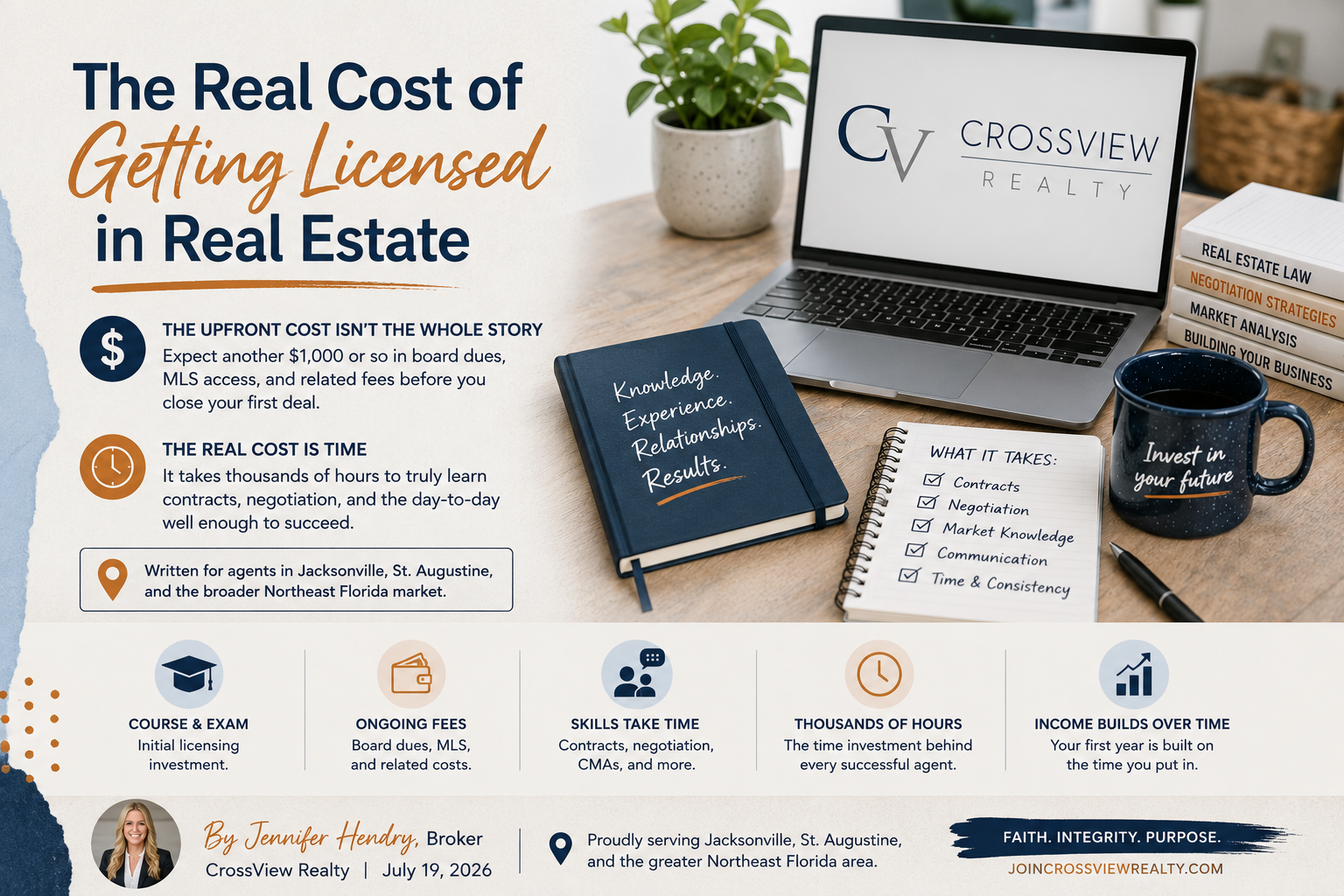
The upfront licensing fee is only part of it. Once you pass your exam and hang your license with a brokerage, you're typically looking at another $1,000 or so in board dues, MLS access, and related fees before you close a single deal. But the bigger cost isn't money at all — it's the thousands of hours it takes to actually learn contracts, negotiation, and the day-to-day of the job well enough to succeed.
I get asked "how much does it cost to get a real estate license in Florida" all the time, and we've broken that number down in detail elsewhere — the course, the state exam, the application fees. That's a fair question, and worth answering clearly.
But it's not the question that actually determines whether someone succeeds in this business. Here in Jacksonville and across Northeast Florida, the agents who struggle aren't usually the ones who underestimated the licensing fee. They're the ones who underestimated everything that comes after it.
The Cost Nobody Budgets For: Keeping Your License Active
Most people researching this only budget for the cost of getting licensed — the course, the exam, the application. What catches almost everyone off guard is that the moment you pass and hang your license with a brokerage, you're immediately looking at additional costs on top of that: board dues, MLS access, and related fees that can easily add another $1,000 before you've closed a single transaction.
That's not a hidden fee or a gotcha — it's just a cost most people never think to ask about, because all the attention goes to "how much is the license" and none of it goes to "what does it cost to actually use it." If you're budgeting for a real estate career, budget for both.
The Real Cost Is Time, Not Money
Here's the thing I hear most from newer agents, almost without fail: they had no idea how hard real estate actually is.
Not hard in the sense of the licensing exam — hard in the sense of everything that comes after. Learning contracts well enough to actually understand what you're signing your clients up for. Writing offers that protect your client and still get accepted. Negotiating repairs after an inspection without blowing up the deal. Running a real comparative market analysis instead of guessing at a number. None of that is covered in a 63-hour pre-licensing course, and none of it comes naturally on day one.
There's a common assumption that this job is basically opening a door and writing up an offer when someone says yes. It isn't. There are thousands of hours of learning behind every agent who's actually good at this — reading contracts until you understand them cold, sitting through negotiations until you know how to hold your ground, running enough CMAs that you stop second-guessing your numbers.
If You Don't Have the Time, It's Not the Right Time
So here's the real question, and it's not "how much does it cost to get a real estate license in Florida." It's: how much time and energy do you actually have to devote to this once you have it?
Income doesn't show up on day one no matter how fast you close your first deal — it builds as you build the skill and the relationships behind it. And what actually drives that first year of income has far more to do with the time you put in than the license itself.
If you're weighing whether now is the right time to get licensed, be honest with yourself about your bandwidth before you spend the money. A real estate license doesn't do the work for you — it just gives you the chance to start doing it. If you don't have the time to put toward learning contracts, negotiation, and the actual craft of this job right now, it might genuinely be the wrong season to start, and that's a completely reasonable thing to recognize about yourself.
Frequently Asked Questions
How much does it cost to maintain a Florida real estate license, not just get one?
Once you activate your license with a brokerage, expect an additional $800–$1,400 or more in board dues, MLS access, and related fees on top of the initial licensing cost, depending on when in the year you join.
What are the ongoing costs after you activate your license with a brokerage?
Local Realtor board dues, MLS access, and lockbox or key access fees are the most common ongoing costs new agents don't anticipate. These typically come due shortly after you affiliate with a brokerage.
How long does it really take to become successful in real estate?
Most agents close their first deal within 3 to 6 months, but real skill — contracts, negotiation, running accurate CMAs — takes much longer to build, often well beyond the first year.
Is it hard to make money as a new real estate agent?
It can be, particularly in the first year, because income depends on skills that take real time to develop. Agents who underestimate the learning curve tend to struggle more than agents who underestimate the licensing cost.
How much time should I expect to spend learning after I get licensed?
Plan on a significant, ongoing time investment — well beyond your pre-licensing course. Understanding contracts, writing strong offers, negotiating repairs, and running comparative market analyses are all skills built through repetition, not covered in your original coursework.
If you're weighing whether now is the right time to get licensed in Jacksonville, St. Augustine, or the broader Northeast Florida market, reach out directly at recruiting@crossviewrealty.com or 904-503-0672 — we'd rather have an honest conversation about the time commitment than let you find out the hard way. You can also request a meeting directly.
About the Author Jennifer Hendry is the Broker/Owner of CrossView Realty, an independent, faith-led real estate brokerage based in Jacksonville, Florida, serving Duval, St. Johns, Clay, and Nassau counties. Learn more at joincrossviewrealty.com.