What Factors Influence Real Estate Agent Income in the First 12 Months?
If you just got your license — or you're close to getting it — this is probably one of the first questions on your mind.
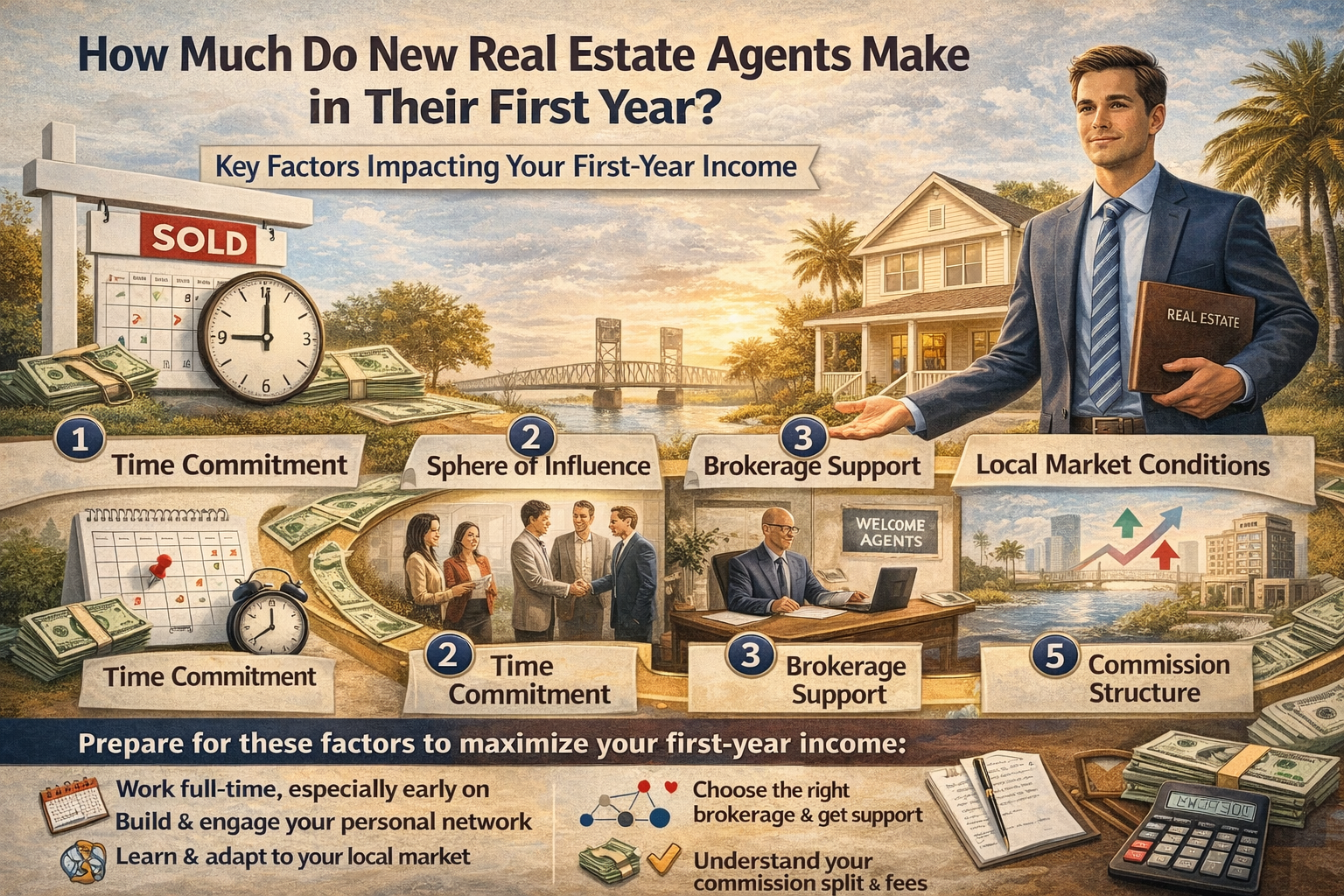
The factors that most influence a new real estate agent's income in the first 12 months are time commitment, sphere of influence, brokerage support, local market conditions, and commission structure. Some of these you can control completely. Others you can prepare for. None of them are a mystery — but most new agents don't fully understand them until they're already in the middle of year one.
Here's what you actually need to know before you get started.
This Is Not a Salaried Career — and That Changes Everything
Before diving into the specific factors, it helps to understand the foundation. Real estate income is commission-based, which means you don't earn anything until a transaction closes. There's no base pay, no guaranteed weekly check, and no income floor while you're building your business.
That's not a reason to avoid the career — it's a reason to go in with a real plan. The agents who struggle in year one almost always do so because they underestimated the gap between getting licensed and getting paid. The agents who thrive are the ones who understood that gap ahead of time and prepared for it.
Factor 1: How Much Time You Actually Put In
This one isn't complicated, but it's worth saying plainly: real estate rewards full-time commitment, especially in year one.
An agent treating their license like a side project will almost always produce side-project results. The reason isn't talent — it's availability. Real estate moves on clients' schedules, not yours. Buyers want to see homes on weekends. Sellers want callbacks the same day. Leads go cold fast. The agents who build momentum quickly are the ones who can respond, show up, and stay consistent — and that's much harder to do when real estate is your second priority.
That doesn't mean part-time is impossible. But if you're going to do this part-time in year one, go in knowing it will likely affect your income and adjust your financial expectations accordingly.
Factor 2: The Size and Strength of Your Sphere of Influence
Your sphere of influence — the people who already know you and trust you — is the single most valuable asset you have as a new agent. You don't have a track record yet, a pile of reviews, or years of referrals to draw from. What you do have is relationships.
New agents who actively work their sphere from day one — letting people know they're licensed, staying top of mind, following up consistently — tend to close their first deals faster than those who wait for leads to come to them. Your first few clients will almost certainly come from people who know you personally. That network is where your business starts.
The agents who underperform in year one often make the same mistake: they assume their sphere already knows they're in real estate, and they don't actively cultivate it. They do not. You have to tell them, remind them, and give them a reason to think of you when someone they know needs an agent.
Factor 3: The Brokerage You Choose and the Support They Provide
This is the factor that surprises new agents most — because it's not something you can fix after the fact.
Your brokerage directly shapes your first-year income in several concrete ways. The training you receive determines how quickly you become competent and confident enough to convert leads into clients. The mentorship available to you determines how well you handle your first few contracts without costly mistakes. The tools and systems your brokerage provides affect how efficiently you work every single day.
A new agent at a brokerage that invests in their development can compress the learning curve significantly. A new agent who lands somewhere that hands them a login and wishes them luck is going to spend months figuring things out the hard way — and that costs time, which in a commission-based career, costs money.
Before you commit to a brokerage, ask specifically: What does my first 90 days look like here? Is there a mentor program? How accessible is the broker when I have a question on a live deal? The answers will tell you everything.
Factor 4: Local Market Conditions in Northeast Florida
Your income in year one is also shaped by the market you're working in — and in Northeast Florida, that picture is worth understanding.
The Jacksonville metro, St. Augustine, Ponte Vedra Beach, Nocatee, Fleming Island, Orange Park, St. Johns, and the surrounding communities make up one of the more active real estate markets in the Southeast. Population growth, continued development, and consistent demand across multiple price points mean there's real opportunity here for agents who are ready to work it.
That said, market conditions shift. Interest rates affect buyer activity. Inventory levels affect how competitive listings are. A new agent entering the market when buyer demand is high will have a different first-year experience than one entering during a slower cycle. You can't control the market — but you can stay educated about it and position yourself to work whatever conditions you're in rather than waiting for ideal ones.
Factor 5: Your Commission Split and Brokerage Fee Structure
How much of each commission check you actually keep matters — and the answer isn't as simple as the headline split percentage your brokerage quotes you.
In addition to the commission split itself, most brokerages charge some combination of monthly fees, transaction fees, E&O insurance, and technology or marketing costs. Two brokerages with similar headline splits can produce very different net income depending on how those fees add up over the course of a year.
As a new agent evaluating your options, ask every brokerage for the full picture — not just the split. Add up what you'd actually keep on a typical transaction after every fee. Then consider what you're getting in return. A brokerage that keeps a larger portion of your commission but provides genuine training, mentorship, and tools may deliver more value than one offering a higher split with no support behind it.
How Much Do New Real Estate Agents Make in Their First Year?
The honest answer is: it varies a lot — and that's not a dodge, it's the reality of a commission-based career.
First-year income for new agents ranges widely depending on the factors above. Some agents close several transactions in their first year and earn meaningful income. Others spend most of year one building their foundation and see their real returns in year two and beyond. The agents who stay in the business long enough to get past the initial learning curve consistently see their income grow — sometimes significantly — as their sphere deepens, their skills sharpen, and their referral base builds.
The agents who don't make it through year one almost always ran out of financial runway before they ran out of potential. That's why building adequate reserves before you launch is one of the most important things a new agent can do.
What You Can Control Starting Today
You can't control the market. You can't change commission structures industry-wide. What you can control is how prepared you are when you start.
Choose your brokerage carefully — it's one of the highest-leverage decisions you'll make as a new agent. Work your sphere actively and consistently. Treat your license like the business it is from day one. And give yourself enough financial runway to get through the gap between licensed and profitable without the pressure of a ticking clock forcing bad decisions.
The first 12 months are hard for almost everyone. They're also where the foundation of your entire career gets built. Go in with clear eyes and the right support around you, and you give yourself a real shot at making it.
How CrossView Realty Supports New Agents in Year One
At CrossView Realty, we know that what happens in a new agent's first 12 months shapes whether they build a lasting career or become another attrition statistic. That's why we invest in real training, hands-on mentorship, and a support structure built for agents who are serious about this business — not just getting licensed. We work with agents across Jacksonville, St. Augustine, Ponte Vedra Beach, Orange Park, Nocatee, Fleming Island, St. Johns, and the broader NE Florida market, and we're genuinely invested in seeing our agents succeed past year one.
Ready to Start Your Real Estate Career on the Right Foot?
If you're a newly licensed agent — or you're still deciding whether real estate is the right move — we'd love to have a real conversation about what year one looks like and how we support agents through it.
👉 Visit joincrossviewrealty.com or call CrossView Realty at 904-503-0672
Frequently Asked Questions
Q: What factors influence real estate agent income in the first 12 months? The biggest factors are time commitment, how actively you work your sphere of influence, the quality of support your brokerage provides, local market conditions, and your net commission structure after fees. Some of these are within your control — and focusing on the ones you can influence makes a measurable difference in year one.
Q: How long does it take for a new real estate agent to start making money? Most new agents close their first transaction within the first three to six months, though the timeline varies depending on how actively they work their sphere, how well they're trained, and what market conditions look like. The key is having enough financial reserves to stay in the business long enough to build momentum — agents who run out of runway before they run out of potential are the ones who don't make it through year one.
Q: Does your brokerage really affect how much you earn as a new agent? Significantly. The training, mentorship, and tools your brokerage provides directly affect how quickly you become productive. A new agent with genuine support and guidance will typically compress their learning curve and start closing deals faster than one who's left to figure things out alone. The split matters — but so does everything behind it.
Q: Is it harder to earn money as a part-time real estate agent in your first year? Generally, yes. Real estate income is tied to availability and responsiveness — buyers and sellers move on their schedules, not yours. Part-time agents often have a slower ramp-up in year one simply because they can't be as available as full-time agents. It's not impossible, but it's worth going in with adjusted income expectations if you're starting part-time.
Q: What's the most important thing a new real estate agent in Jacksonville or NE Florida can do to maximize first-year income? Work your sphere early and consistently, choose a brokerage that will genuinely invest in your development, and make sure you have enough financial reserves to stay in the business while you're building momentum. The NE Florida market offers real opportunity — but only for agents who are prepared to show up fully and stay in the game long enough to see results.