Pros and Cons of Forming an LLC as a Florida Real Estate Agent
At some point in your real estate career, someone — a colleague, a CPA, a podcast — is going to tell you that you need to form an LLC. Maybe you're already wondering about it yourself.
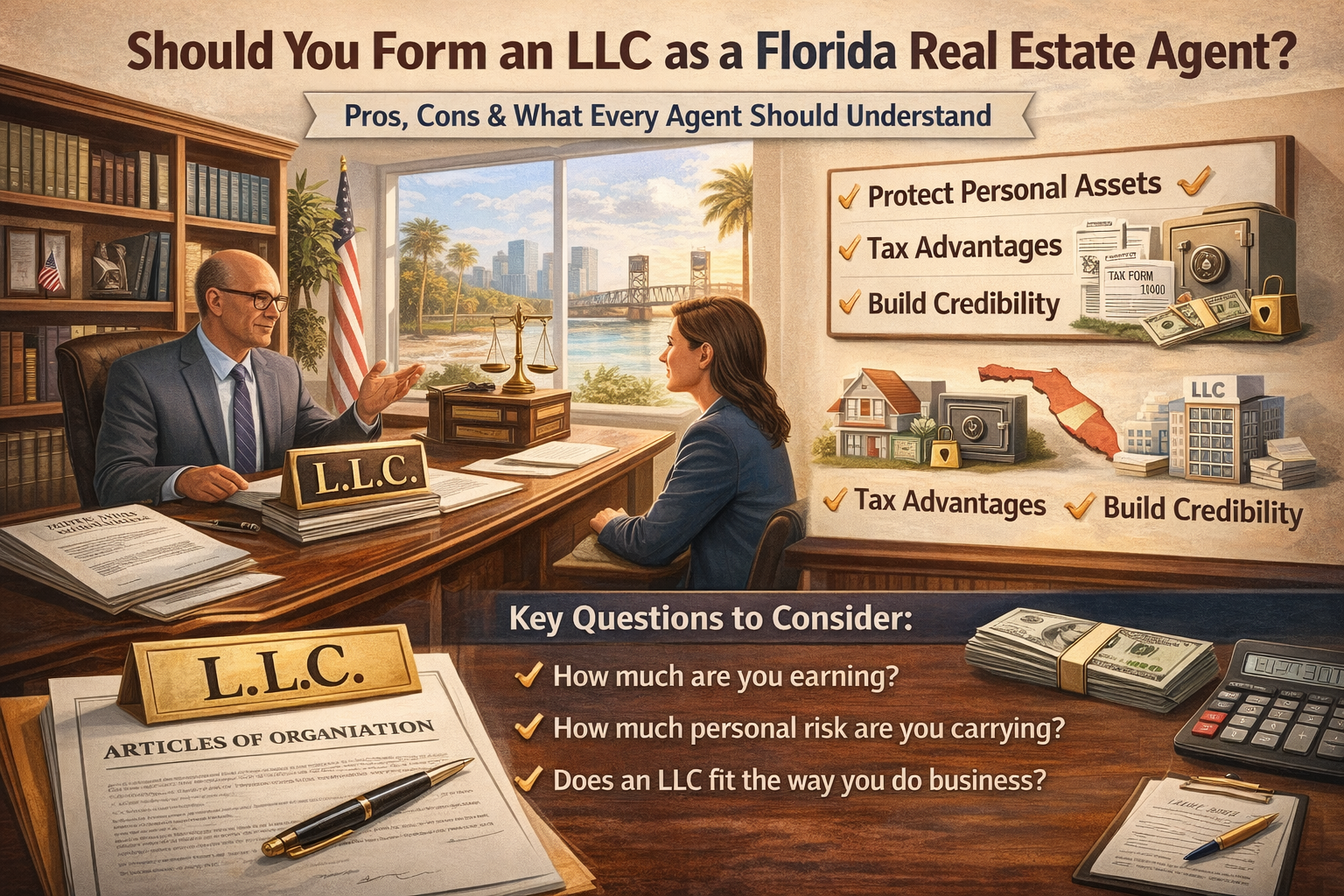
The pros and cons of forming an LLC as a Florida real estate agent come down to three things: how much you're earning, how much personal risk you're carrying, and whether the structure actually fits the way you do business in this state. Here's an honest look at both sides — and what Florida law specifically requires before you make a move.
What an LLC Actually Does — and How Florida Law Shapes It
An LLC — Limited Liability Company — is a business structure that creates a legal separation between you and your business. In plain terms, it means that if a business-related lawsuit or claim arises, your personal assets — your home, your savings, your personal accounts — have a layer of protection that a sole proprietor doesn't have.
That's the core value proposition. Everything else — tax treatment, credibility, business structure — builds from there.
Florida law does allow licensed real estate sales associates and broker associates to hold their license under an LLC or PLLC, but there's a specific requirement that catches a lot of agents off guard: the entity name must match your legal name exactly as registered with the Florida Department of Business and Professional Regulation (DBPR). So if your name is Jane Doe, your entity would need to be registered as Jane Doe, LLC or Jane Doe, PLLC. Florida does not allow you to form a creatively named business entity and route your real estate license through it — the name matching rule exists specifically to maintain accountability under Chapter 475 of Florida Statutes, which governs real estate licensure in this state.
The Pros of Forming an LLC as a Real Estate Agent
Personal asset protection. As an independent contractor, you carry real exposure. A transaction dispute, a client complaint, an errors and omissions claim that exceeds your coverage — any of these can create legal and financial risk. An LLC won't eliminate that risk, but it creates a meaningful barrier between a business liability and your personal financial life. The further along you are in your career and the more you've built, the more that protection matters.
Tax flexibility — with a Florida advantage. Florida has no state income tax, which already puts you ahead of agents in many other states when it comes to take-home pay. By default, a Florida LLC is treated as a pass-through entity — income flows to your personal federal return and gets taxed accordingly. But once your income reaches a level where it makes sense, you can elect S-Corporation tax treatment at the federal level. That election allows you to split your income between a salary and distributions, which can reduce the amount subject to self-employment tax. It's not a strategy for every agent at every income level, but for a consistently producing agent in the Jacksonville or Northeast Florida market, the federal tax savings can be meaningful. This is a conversation worth having with a CPA who specifically works with Florida real estate professionals.
Business credibility and structure. Operating as an LLC signals that you treat your real estate career as a real business — because it is one. For agents who are building a team, working with investors, or managing referral partnerships, the structure adds a layer of professionalism that a sole proprietorship doesn't carry. It also creates a cleaner framework for separating business and personal finances, which is a discipline that serves you well regardless of your tax situation.
A foundation for growth. If you're thinking about eventually building a team, hiring an assistant, or expanding your business in any meaningful way, having an LLC in place early gives you a structure to grow into. It's much easier to build on a proper foundation than to scramble and restructure once you're already moving fast.
The Cons of Forming an LLC as a Real Estate Agent
It costs money to set up and maintain in Florida. Filing Articles of Organization with the Florida Division of Corporations runs about $100, but the ongoing costs add up — Florida requires an annual report filing each year to keep your LLC in good standing, which carries its own fee. Add in a registered agent (required in Florida), a separate business bank account, and potentially more complex accounting, and the overhead is real. For an agent in the early stages of their career in the Florida market, that ongoing cost may not be justified yet.
Florida's commission payment rules add a layer of complexity. This is the piece that trips up a lot of Florida agents. Under Florida law and DBPR regulations, you generally cannot receive commission payments through an LLC unless your license is registered with the DBPR in that exact entity name. Many agents who form an LLC still end up getting paid personally because their license isn't properly structured to flow payments through the entity. If routing commissions through your Florida LLC is part of the plan, talk to your broker and a Florida real estate attorney before you set anything up — the DBPR process for registering an entity license has specific steps, and getting it wrong creates compliance headaches.
An LLC isn't a shield if you don't treat it like one. The liability protection an LLC provides disappears quickly if you're commingling personal and business funds, personally guaranteeing business loans, or failing to maintain the basic operational separation the structure requires. The entity only protects you if you actually operate it as a separate business. That takes discipline and, realistically, some ongoing administrative attention.
It may not be necessary yet. If you're a newer agent, still building your pipeline and keeping overhead lean, a sole proprietorship may serve you just fine for now. You can always form an LLC later as your income, assets, and business complexity grow. Doing it before it makes financial sense just adds costs without proportional benefit.
Should a Florida Real Estate Agent Form an LLC?
The honest answer is: it depends on where you are in your career.
If you're producing consistently, have built meaningful personal assets you want to protect, and are ready to treat your real estate business like the business it is — forming an LLC is worth serious consideration. If you're in your first year, still finding your footing, and watching every dollar of overhead — it can wait.
The best thing you can do is sit down with a CPA who works with real estate agents and run the actual numbers for your situation. The right answer isn't the same for everyone, and generalizations only get you so far.
Reminder: This post is for informational purposes only and is not legal or tax advice. Always consult a qualified CPA or attorney before making decisions about your business structure.
How CrossView Realty Approaches This
At CrossView Realty, we believe agents should have access to real information — not just about real estate transactions, but about the business of being an agent. We work with professionals across Jacksonville, St. Augustine, Ponte Vedra Beach, Orange Park, Fleming Island, Nocatee, and the broader NE Florida market, and questions about LLCs, taxes, and business structure come up all the time. We don't give legal or tax advice, but we do make sure our agents know the right questions to ask and the right people to ask them.
Ready to Build a Real Estate Business Worth Protecting?
Whether you're just getting started or you're a producing agent thinking more seriously about structure, strategy, and long-term growth — we'd love to have a real conversation about where you are and what's next.
👉 Visit joincrossviewrealty.com or call CrossView Realty at 904-503-0672
Once you're licensed, resources like the Florida Realtors Legal Hotline give you free access to real estate attorneys for exactly these kinds of questions.
Frequently Asked Questions
Q: What are the pros and cons of forming an LLC as a real estate agent? The main pros are personal asset protection, tax flexibility — including the potential to elect S-Corp treatment — and a more professional business structure. The cons include setup and maintenance costs, added administrative responsibilities, and Florida-specific rules around how commissions can be paid through an entity. Whether it makes sense depends on your income level, assets, and where you are in your career.
Q: Do real estate agents in Florida need an LLC? No — Florida does not require real estate agents to form an LLC. You can practice as a sole proprietor and meet all DBPR requirements. An LLC is a business decision, not a licensing requirement, and it makes the most sense once your income and assets justify the structure.
Q: Can a real estate agent receive commission payments through an LLC in Florida? Generally, only if your license is registered with the DBPR in that exact entity name. For example, if your name is Jane Doe, your entity would need to be registered as Jane Doe, LLC. If your license isn't structured that way, commissions typically still flow to you personally. Talk to your broker and a Florida real estate attorney before setting this up.
Q: When should a real estate agent consider forming an LLC? Most agents benefit from the conversation once they're earning consistent commissions, have personal assets worth protecting, or are starting to grow their business through a team or referral partnerships. If you're in your first year and still building your pipeline, it can usually wait — the overhead may not be worth it yet.
Q: What's the difference between an LLC and a PLLC for real estate agents? A PLLC — Professional Limited Liability Company — is similar to an LLC but is designed specifically for licensed professionals. In Florida, either structure can be used to hold a real estate license. Your CPA or attorney can help you determine which is the better fit for your specific situation.