What Real Estate School Doesn’t Teach You About Becoming an Agent
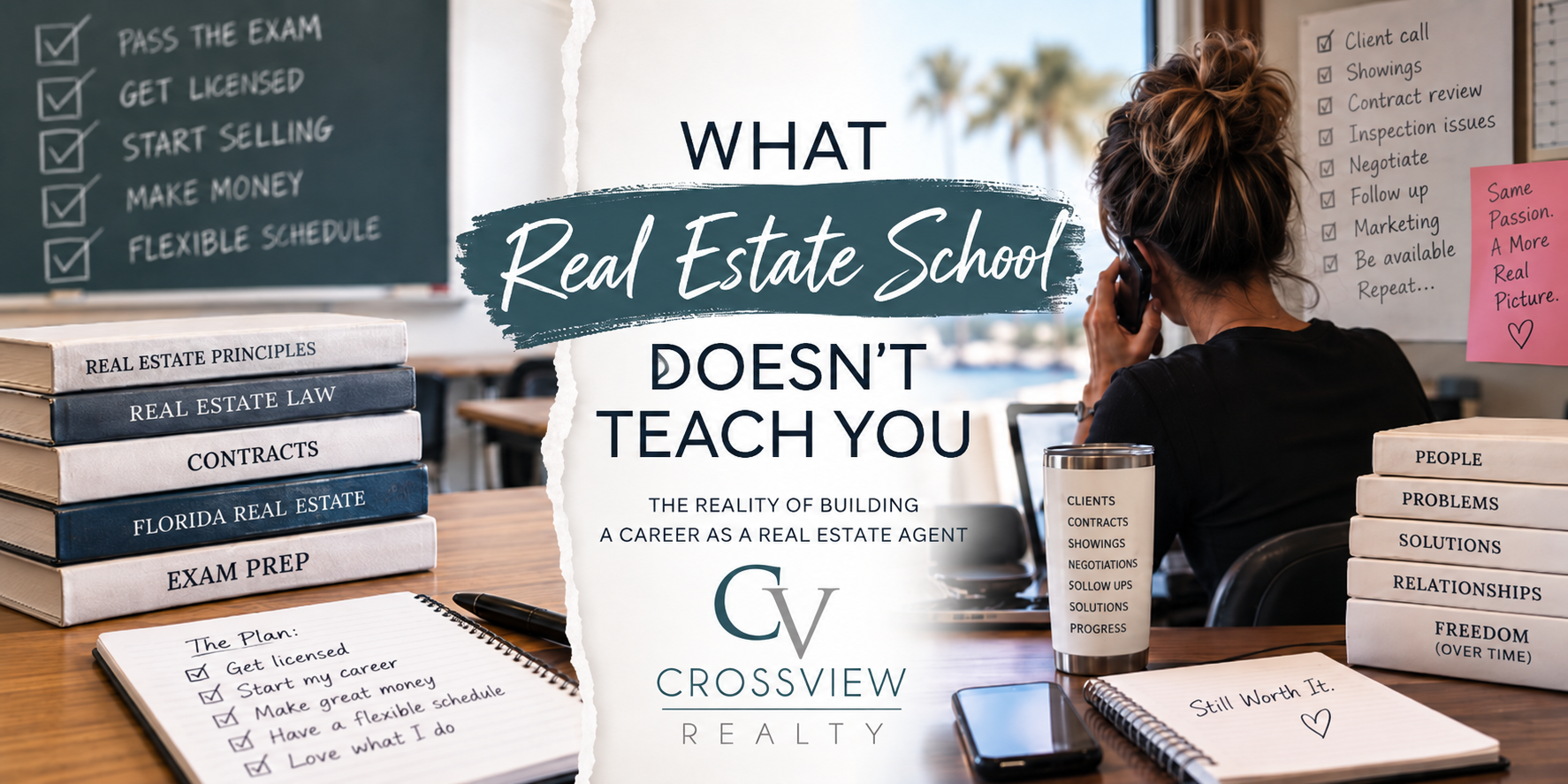
Did real estate school actually prepare you to be a real estate agent?
Not completely. Real estate school can prepare you to pass your exam and earn your license, but becoming a good real estate agent requires an entirely different level of learning—contracts, negotiation, market knowledge, problem-solving, client service, business development, and real-world experience.
And I think this is one of the biggest surprises for people entering this industry.
I hear some version of it all the time:
“I had no idea there was this much to learn.”
Or:
“I really didn’t think real estate was going to be this hard.”
I get it.
From the outside, real estate can look pretty glamorous. Social media shows the closing photos, new listings, coffee meetings, networking events, flexible schedules, beautiful homes, and commission checks.
It usually doesn’t show the contract question at 9:00 at night.
Or the inspection problem.
Or the client who needs an answer right now.
Or the buyer who suddenly wants to see a house while you’re supposed to be somewhere else.
Or the months of prospecting, follow-up, training, and learning that happened before that smiling closing-table photo ever existed.
Real estate can be an incredible career.
But easy?
No.
What Real Estate School Doesn’t Teach You About the Actual Job
Getting licensed gives you permission to practice real estate.
It does not automatically make you good at practicing real estate.
That distinction matters.
You can learn contract terminology in a classroom. It’s different when you have a nervous buyer under contract, an inspection deadline approaching, a repair issue on the table, and multiple people trying to figure out what happens next.
You can learn the definition of negotiation. It’s different when you’re actually negotiating on behalf of a client and every word, deadline, and decision matters.
You can learn basic market concepts. But being a professional means staying current enough to help a client understand what is happening right now in Jacksonville, St. Johns, Orange Park, Ponte Vedra, or wherever you’re working in Northeast Florida.
And you have to keep learning.
Markets change.
Contracts and forms change.
Technology changes.
Marketing changes.
Consumer expectations change.
The business you learn today will not look exactly the same five years from now.
That’s one reason I think new agents should look at their first year very differently. You’re not finished with school because you passed the exam.
In a lot of ways, you just started.
We’ve talked before about what actually matters in your first 90 days as a real estate agent. Those early months aren’t just about finding a client. They’re about getting enough exposure, repetition, coaching, and experience that you begin turning information into judgment.
Because eventually, clients aren’t just paying you to know things.
They’re relying on you to know what to do with what you know.
The best agents learn to see problems before they become problems.
That comes from experience.
It also comes from asking questions, studying contracts, attending training, listening to experienced agents, paying attention to what happens inside transactions, and staying humble enough to realize you’ll never know everything.
If you’re newly licensed and wondering whether your brokerage is giving you enough opportunity to actually learn the business, fill out the Request a Meeting form on our website or call the CrossView Realty office at (904) 503-0672. We’re happy to have an honest conversation about where you are, what you need, and what support really looks like as you build.
The Reality of a Real Estate Career Is Different From Social Media
Real estate does offer flexibility.
But I think we need to be much more honest about what that means—especially for new agents.
When you’re building a business, flexibility doesn’t necessarily mean you work whenever you feel like working.
Sometimes it means your schedule has to flex around your clients.
A serious buyer may find a house they want to see while you’re at dinner.
A seller may call while you’re on vacation.
A problem may come up during a transaction when you had something completely different planned.
There are producing agents who have answered phone calls from beaches, kids’ activities, restaurants, airports, and hotel rooms.
Should that be the goal forever?
No.
As you build your clientele, systems, experience, and financial stability, you can start creating stronger boundaries. You can structure your business differently. You can build coverage. You can become more intentional about when you’re available.
But when you’re brand-new and you only have one active client, telling that client, “That time doesn’t work for me,” can feel very different than it does when you have an established referral business and systems around you.
That’s why our article on whether part-time real estate actually works spends so much time talking about availability. This business doesn’t always operate between 9:00 and 5:00.
The freedom people associate with real estate can absolutely become part of the career.
But for many agents, that freedom is built over time.
It isn’t handed to you with your license.
The same is true financially.
You’ve probably seen dramatic statistics online about how many real estate agents “fail.” I’m cautious about repeating those numbers because people rarely define what failure actually means or where the statistic came from.
What is worth understanding is that early-career real estate income can be extremely uneven. Newer agents generally earn substantially less than agents who have spent years developing skills, relationships, repeat clients, and referral business.
There may be weeks—or months—between commission checks.
That’s why we’ve also written about realistic first-year income for new real estate agents. Going into this career with realistic financial expectations isn’t negative.
It’s responsible.
Being a Good Real Estate Agent Requires More Than Being Good With People
Personality matters in real estate.
Relationships matter tremendously.
But being friendly, outgoing, or good at networking is not enough.
A great agent has to develop a pretty wide range of skills.
You need to learn how to communicate clearly.
You need to listen well.
You need to understand contracts.
You need to know when you don’t know something and ask for help.
You need to negotiate without making everything adversarial.
You need to manage your emotions when everyone else in the transaction is emotional.
You need to follow up when you don’t feel like following up.
You need to understand your local market well enough to have intelligent conversations with clients.
You need to manage your time.
You need to generate business.
You need to pay attention to details.
And one of the biggest skills of all is learning to anticipate.
A good agent reacts to problems.
A really good agent starts recognizing where problems are likely to show up and works to get ahead of them.
That takes time.
It takes transactions.
It takes mistakes you learn from, conversations with people who know more than you, and a willingness to keep developing long after your licensing class is over.
There’s no shortcut around that.
And I actually think that’s good news.
Because it means this career isn’t reserved for the person with the biggest personality, the most Instagram followers, or the largest sphere on day one.
There is a craft to this profession.
And you can get better at the craft.
How CrossView Approaches This
At CrossView Realty, we don’t expect a new agent to walk through the door knowing how to handle everything.
We do expect them to want to learn.
That’s why we put so much emphasis on mentorship, hands-on training, accessible broker guidance, and being together enough that agents can learn from real situations—not just prerecorded material. We believe there’s tremendous value in sitting with someone, working through the problem, understanding why something matters, and then being better prepared the next time it comes up.
For us, that’s also part of stewardship. Clients are trusting us with major decisions, and we should take that responsibility seriously. That doesn’t mean an agent has to be perfect. It means we should always be growing, learning, asking, and doing our best to serve people well.
The Final Takeaway
If you’re considering real estate because you think it’s easy money with a completely flexible schedule, I’d encourage you to look deeper before you jump in.
But if you like learning, you’re willing to work, you care about people, you can handle some uncertainty, and you want to develop a real professional skill set, real estate can be a deeply rewarding career.
Just don’t confuse getting licensed with being finished learning.
The license gets you through the door. Becoming a great agent is what happens after that.
If you’re a new or recently licensed agent in Jacksonville or Northeast Florida and you’re looking for a brokerage where you can learn the actual business—not just hang your license—we’d love to have a conversation.
Fill out the Request a Meeting form on our website to take the first step. It gives us a chance to learn a little about you and start a real conversation about your goals, the support you’re looking for, and whether CrossView Realty may be a good fit.
Or, if you’d rather talk to someone directly, call our office at (904) 503-0672.
No pressure. Just a conversation.
Frequently Asked Questions
Q: What does real estate school not teach you?
A: Real estate school gives you foundational knowledge and prepares you for licensing requirements, but much of the day-to-day skill of being an agent develops through actual practice. Negotiating a live transaction, managing client expectations, spotting potential problems, understanding your local market, generating business, and learning how to guide people through stressful decisions all take additional training and experience. That’s why ongoing mentorship and broker support can matter so much early in your career.
Q: Is being a new real estate agent harder than real estate school?
A: For many agents, yes—and that surprises them. Studying for an exam gives you a defined curriculum and a clear finish line. Building a real estate business doesn’t. You’re learning the job while also trying to generate clients, manage your finances, develop confidence, and respond to real situations where the answer isn’t always obvious.
Q: How long does it take to become a good real estate agent?
A: There isn’t a set timeline. The number of transactions you’re exposed to, the quality of your training, how actively you work, the market you’re in, and the people you learn from all affect how quickly you develop. What matters more than an arbitrary number of months is whether you’re consistently getting experience, asking questions, studying the business, and improving your judgment.
Q: Can a new real estate agent really have a flexible schedule?
A: Real estate can eventually provide a great deal of flexibility, but new agents need realistic expectations. Clients, showings, inspections, negotiations, and transaction issues don’t always happen during convenient hours. As your business becomes more established, you may be able to build stronger boundaries and systems, but availability can be especially important while you’re trying to build your initial client base.
Q: What should a new real estate agent look for in a brokerage?
A: Look beyond the commission split. Ask how you’ll learn contracts, who you call when something goes wrong, whether the broker is actually accessible, what training looks like after onboarding, and whether you’ll have opportunities to learn from active transactions. For a new real estate agent in Jacksonville or Northeast Florida, the environment you choose can shape how supported—and how prepared—you feel while you’re learning the business.
About Jennifer Hendry
Jennifer Hendry is the Broker/Steward of CrossView Realty, a Christ-centered brokerage serving Northeast Florida. She's built CrossView around mentorship and genuine support, helping agents at every stage — from brand-new licensees to seasoned professionals — grow their business and reach their full potential.
CrossView Realty · (904) 503-0672. Agents at CrossView Realty are independent contractors, not employees. This article is general information only and does not constitute legal, tax, or financial advice. It is not a guarantee of income, earnings, or production — individual results vary based on effort, market conditions, and experience. Confirm your specific situation with an attorney, tax advisor, or the DBPR as needed.