How to Choose a Real Estate Broker: Don’t Just Interview the Brokerage
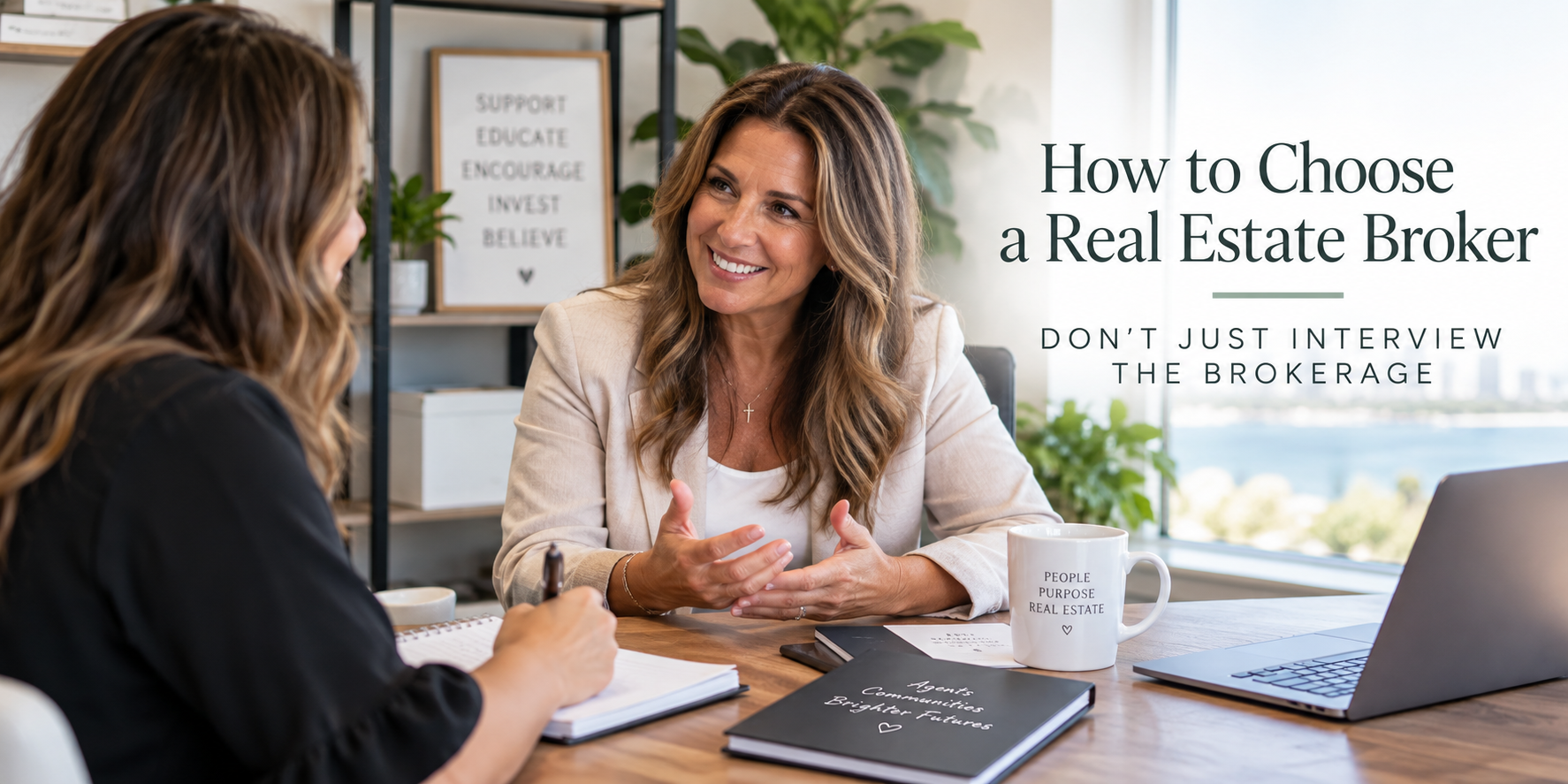
When you’re choosing where to hang your real estate license, are you interviewing the brokerage—or are you also interviewing the broker?
If you want to know how to choose a real estate broker, start by looking beyond the company name. Find out who is actually responsible for supervising your work, how accessible that person is, and what happens when you need guidance on something important.
I think this is a step a lot of agents miss.
We spend so much time talking about how to choose a brokerage. What’s the commission split? What technology do they offer? Do they provide leads? What’s the training like? What’s the culture?
Those are all good questions.
But there’s another person you need to be evaluating, too.
The broker.
You’re Choosing More Than a Brokerage Name
The way a real estate company is structured can vary quite a bit.
At a large franchise or multi-office company, there may be several offices with different leadership at each location. So even after you decide you like the overall brokerage, you may still have another decision to make: Which office do you want to join, and who is the broker overseeing that office?
At a smaller independent brokerage, the structure may look completely different. There may be one broker overseeing the whole company and working much more directly with the agents.
Neither structure is automatically better.
That’s important.
A large brokerage can have a fantastic broker who is engaged, organized, and surrounded by a strong leadership team. A smaller brokerage can have a broker who is stretched too thin. And the reverse can be true, too.
This is why I’ve said before that the real question isn’t always independent versus franchise. You have to look at the actual people, systems, and support behind the name.
Why the Broker Matters in Florida Real Estate
There’s a practical reason this matters beyond whether you like someone’s personality.
In Florida, sales associates work under the direction, control, or management of a broker. Florida law also places supervisory responsibilities on brokers for the sales associates registered with them.
So the broker isn’t just the person whose name appears somewhere in the company paperwork.
There is real responsibility attached to that role.
Now, that does not necessarily mean your broker will be the person you call every time you have a basic question.
In a larger company, you may have a team leader, mentor, trainer, transaction coordinator, office manager, or another experienced person who handles many of your day-to-day questions. That can work very well.
But I still want to know this:
If something important comes up, is the broker engaged enough to know what is happening and accessible enough to step in when necessary?
Because eventually, something will come up.
Real estate has a funny way of doing that.
How to Choose a Real Estate Broker: Ask About Accessibility
Accessibility doesn’t mean your broker needs to answer the phone in two rings at 10:30 on a Saturday night.
That’s not realistic, and that’s not what I mean by broker support.
What you’re trying to understand is the structure.
Ask questions like:
- Who do I normally go to when I have a contract question?
- When does the broker personally get involved?
- If my usual point of contact doesn’t know the answer, what happens next?
- How many agents does this broker oversee?
- What is the normal response time when something is urgent?
- Does the broker regularly interact with the agents in this office?
- How are contracts, compliance issues, and unusual situations handled?
- If I need to speak directly with the broker, can I?
Those answers will tell you a lot more than, “Oh yes, our broker is always available.”
Ask what available actually means.
We have a more complete broker interview checklist for real estate agents if you’re actively comparing offices. Take the questions with you. A good brokerage shouldn’t be bothered by thoughtful questions before you make a career decision.
Pay Attention to the Broker’s Level of Engagement
I would also pay attention to how involved the broker appears to be in the actual business.
Do they know their agents?
Do they understand what’s happening inside the office?
Are they involved in training, compliance, problem-solving, or agent development?
Do the agents seem comfortable approaching them?
You don’t necessarily need a broker who is personally involved in every detail of your business. In fact, as a brokerage grows, that becomes less realistic.
What you do want is a broker who has built a structure that works.
There should be a clear answer to the question, “Where do I go when I need help?”
And there should be another clear answer to, “What happens when this is serious enough that I need the broker?”
That distinction matters.
It’s one of the reasons real broker support is about much more than whether somebody gives you their cell phone number on your first day.
How CrossView Approaches This
At CrossView Realty, I’m the Broker/Steward, and I take that responsibility seriously.
That doesn’t mean every question from every agent has to come directly to me. As we’ve grown, we’ve intentionally built mentorship, training, experienced leadership, and support around our agents so they have multiple places to get help.
But I’m still engaged in the brokerage.
I know our agents. I’m involved. And when something reaches the point where broker involvement is needed, I want our agents to know that I’m accessible.
That structure is important to me because we don’t want agents in Jacksonville or across Northeast Florida feeling like they’re out there conducting business with no one paying attention.
The Brokerage Interview Should Include the Broker
So when you’re deciding where to hang your license, don’t stop once you’ve decided you like the brokerage.
Find out who the broker is.
Find out how the office is structured.
Find out how many layers sit between you and that person.
And then decide whether that structure gives you the level of access and support you need.
That answer is going to be different for different agents. An experienced agent who closes dozens of transactions a year may need something very different from someone working through their first three contracts.
That’s okay.
The goal isn’t to find one brokerage structure that everybody should choose.
It’s to understand what you’re actually choosing.
If you’re considering a brokerage move in Jacksonville or Northeast Florida, you’re welcome to request a meeting with CrossView Realty. The conversation is meant to help you understand our structure, support, culture, and expectations so you can decide whether it fits what you’re looking for.
Frequently Asked Questions
Q: How do I choose a real estate broker?
A: Start by finding out who will actually supervise your real estate activity and how the brokerage is structured around that person. Ask about accessibility, contract support, compliance, communication, and what happens when an issue needs the broker’s direct involvement. You’re evaluating leadership, not just personality. The right setup is one where you understand exactly where to turn when you need help.
Q: Should I meet the broker before joining a real estate brokerage?
A: I think you should whenever it’s reasonably possible. If you’re joining a large organization, the recruiting process may involve several other people first, but you should still understand who the broker responsible for your office is and what their role looks like. If meeting that person isn’t part of the process, ask why. You’re making an important professional decision, and knowing the leadership you’ll be working under is worth the extra step.
Q: Does my real estate broker have to answer all of my questions personally?
A: No. A well-structured brokerage may have mentors, trainers, team leaders, or other experienced people who handle many day-to-day questions. The bigger issue is whether there is a clear support structure and whether the broker remains appropriately engaged and accessible when broker-level guidance is needed. You shouldn’t have to guess who to call when something important happens.
Q: Is a smaller brokerage better if I want more access to the broker?
A: Not necessarily. Smaller companies can sometimes create more direct access, but company size by itself doesn’t tell you how responsive or involved the broker will be. A large office with a strong leadership structure may provide excellent support, while a small broker can still be difficult to reach. Ask how the brokerage actually operates rather than assuming based on size.
Q: What should Jacksonville agents ask a broker before changing brokerages?
A: Ask who handles everyday questions, how contract and compliance issues are reviewed, when the broker gets involved, and how easy it is to reach the broker when necessary. You should also understand the brokerage’s training, mentorship, commission structure, technology, and culture. Choosing a real estate broker in Jacksonville or anywhere in Northeast Florida should be about the whole working relationship—not just the number on the commission agreement.
About Jennifer Hendry
Jennifer Hendry is the Broker/Steward of CrossView Realty, a Christ-centered brokerage serving Northeast Florida. She's built CrossView around mentorship and genuine support, helping agents at every stage — from brand-new licensees to seasoned professionals — grow their business and reach their full potential.
CrossView Realty · (904) 503-0672. Agents at CrossView Realty are independent contractors, not employees. This article is general information only and does not constitute legal, tax, or financial advice. It is not a guarantee of income, earnings, or production — individual results vary based on effort, market conditions, and experience. Confirm your specific situation with an attorney, tax advisor, or the DBPR as needed.