Why Some High-Split Brokerages Can Cost Agents More Long-Term
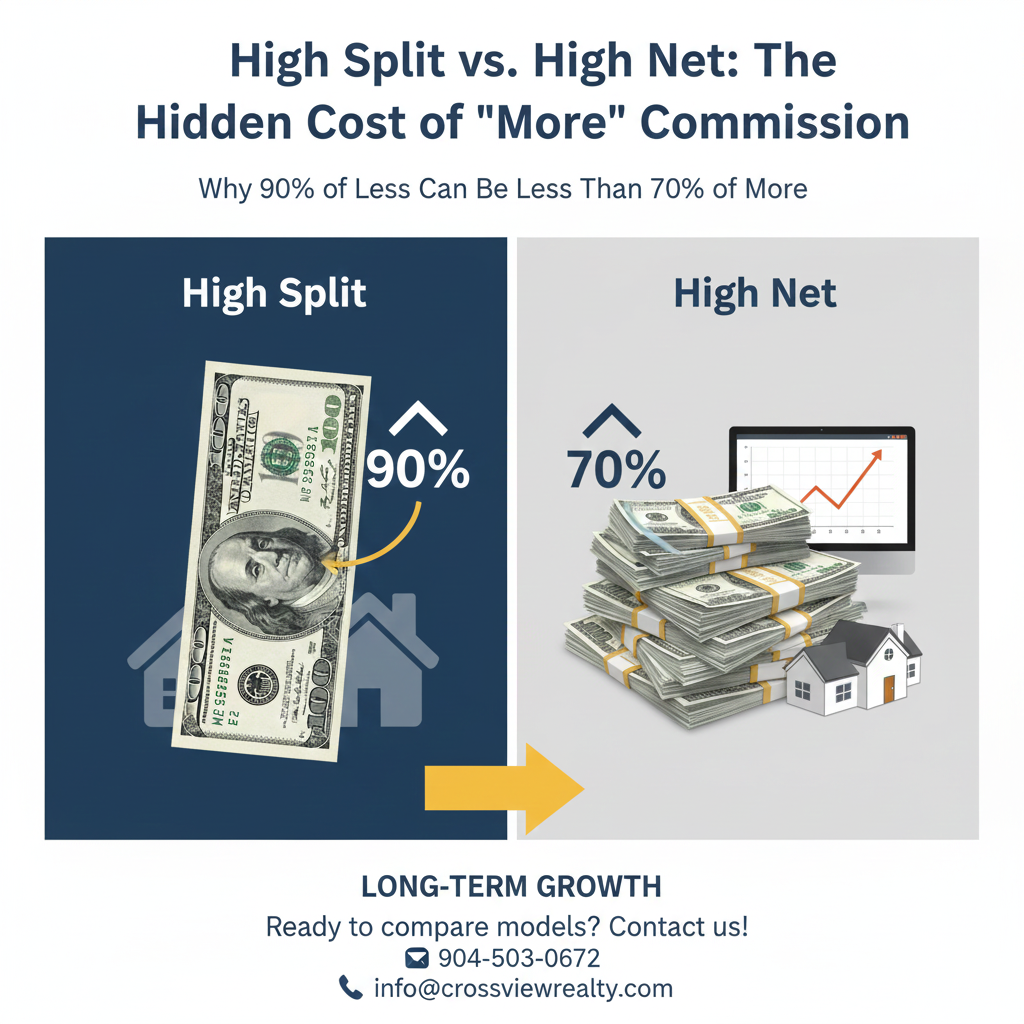
If you’re keeping more of your commission, how could a high-split brokerage possibly cost you more in the long run?
On the surface, high splits sound like the obvious win. You keep more money per deal. You see bigger checks. And it feels like you’re finally being paid what you’re worth.
But here’s the part that doesn’t get talked about enough: more money per transaction doesn’t always mean more money overall.
The Appeal of a High Split
Let’s start with why high-split brokerages are so attractive.
They promise:
More money in your pocket per deal
Less going to the brokerage
More independence
Fewer rules
And for some agents, that model works extremely well.
But it only works when a few key things are already in place.
More Per Deal Doesn’t Matter If You Close Fewer Deals
This is the biggest disconnect.
Yes, you might keep:
90%
95%
Or even “100%” (with fees)
But if that model results in you:
Selling fewer homes
Losing momentum
Spending more time figuring things out on your own
…the math can flip very quickly.
At the end of the year:
50% of something is better than 100% of nothing
And 70% of more is often better than 90% of less
Production matters more than split percentage.
The Hidden Cost: What You’re Not Getting
High-split brokerages often require agents to be far more self-sufficient.
That can mean:
Little to no lead support
Minimal training
Limited broker involvement
Fewer systems or accountability
None of that is bad—if you truly don’t need it.
But many agents don’t realize what they’re missing until:
Business slows
The market shifts
Or they hit a plateau
At that point, the high split doesn’t feel so generous anymore.
Support and Systems Drive Volume
Research across the industry consistently shows that:
Agents with strong systems close more deals
Agents with accountability stay more consistent
Agents with support adapt faster when markets change
Brokerages that offer those things often:
Take a larger portion of each deal
Cap commissions
Or bundle services into the split
But the trade-off is often higher overall production.
And higher production usually wins long-term.
Time Is Money (And Burnout Is Real)
Another long-term cost of high-split models is time.
When you’re responsible for:
All your marketing
All your follow-up
All your systems
All your training
All your compliance
You’re spending hours not selling.
Some agents thrive in that environment. Others burn out quietly—especially when the market tightens.
Burnout doesn’t show up on a commission statement, but it absolutely affects long-term income.
High Splits Can Mask Stagnation
This is subtle, but important.
A high split can make it feel like you’re doing well—even when your business has stalled.
Bigger checks per deal can hide:
Fewer transactions
Inconsistent pipelines
Missed opportunities
Over time, agents sometimes realize they’ve been standing still while the market moved forward.
This Isn’t About “Good” or “Bad” Brokerages
High-split brokerages aren’t bad.
Lower-split brokerages aren’t better.
The real question is:
Does this model help me sell more homes?
Does it support where I am in my career right now?
Will this structure still work if the market shifts again?
The wrong model—even with a great split—can quietly cost you more than you realize.
Final Takeaway
A high split feels good on a single transaction.
But long-term success is about:
Volume
Consistency
Support
And sustainability
Sometimes paying more to a brokerage means you actually walk away with more at the end of the year.
The goal isn’t the biggest split.
It’s the biggest net result.
Let’s Talk
If you want to break down real numbers, compare models honestly, or figure out what structure actually makes sense for your business, we’re always happy to talk it through.
CrossView Realty
📞 904-503-0672
📧 info@crossviewrealty.com
No pressure. Just honest conversations and clarity.