What Does a “Good” Commission Split Actually Look Like in Today’s Market?
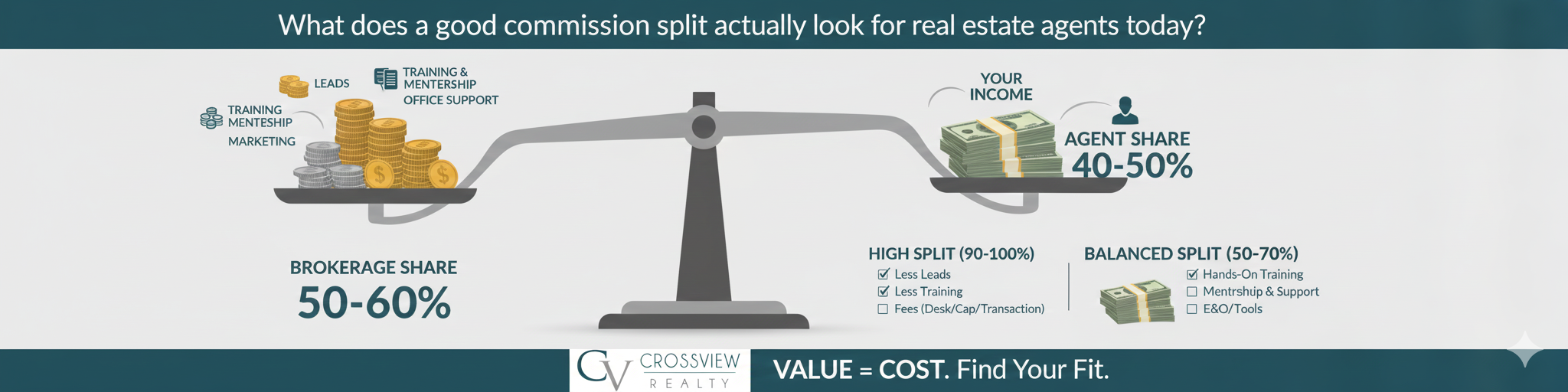
What does a good commission split actually look like for real estate agents today?
This is one of the most common questions agents ask—and one of the hardest to answer honestly.
Why? Because almost every answer you hear comes with bias.
A brokerage that takes a larger portion of the commission is going to explain why their split makes sense. A brokerage that advertises a high split is going to explain why that model is the best. And both will usually point to different benefits to justify it.
So let’s strip this down and talk about what really matters.
Why There’s No One “Right” Split
The truth is, there is no universal definition of a “good” split.
A good split for one agent can be a terrible split for another.
It all comes down to:
What you actually need
What the brokerage is providing
And whether the value you’re getting is worth what you’re paying
Once you understand that, the noise around splits starts to fade pretty quickly.
Brokerages That Provide Leads
Let’s start with leads, because this is where a lot of confusion comes in.
In most cases, brokerages that provide high-quality, consistent leads are going to take a larger portion of the commission. That’s just reality.
You’ll often see:
50/50 splits
60/40 splits
Or team splits that heavily favor the lead source
And there’s a reason for that. Relocation leads, Zillow leads, Realtor.com leads, and other high-intent lead sources are expensive. Someone has to pay for them.
Where agents get tripped up is when they hear:
“You’re on a 90/10 split.”
…but then find out later that:
The lead comes with a high backend referral fee
Or a second split kicks in after the commission closes
So yes, the front-end split looks great—but the math tells a different story.
In general, when you hear great leads, expect a more balanced split. When you hear very high splits, expect fewer or lower-quality leads.
Training and Broker Involvement Matter
Training is another area where splits make sense once you look closer.
Brokerages that offer:
Live, in-person training
A highly involved broker
Hands-on support and accountability
Immediate access for questions
…are almost always going to take a larger split.
Brokerages that advertise:
“Unlimited training”
“Massive resource libraries”
“Everything you need online”
…often rely on prerecorded or virtual content.
And there’s nothing wrong with that—if that’s what you want.
But you should ask yourself:
What’s the difference between that and something I could Google, watch on YouTube, or listen to on a podcast?
Again, it’s not about good or bad. It’s about fit.
The Truth About “100% Brokerages”
Let’s clear something up.
There is no true 100% brokerage.
Every brokerage is taking money somewhere.
That might look like:
Monthly desk fees
Transaction fees
Annual caps
Technology fees
Mandatory services
Some brokerages allow you to reach a cap where you keep 100% after you’ve paid in a certain amount—but you’re still paying.
So when evaluating these models, don’t stop at the headline. Look at the full picture.
What a “Good” Split Really Comes Down To
Here’s the simplest way to think about it.
If you make $100,000 and your brokerage keeps $50,000, ask yourself:
Did I receive $50,000 worth of value?
If you make $100,000 and your brokerage keeps $5,000, ask yourself:
Did I receive $5,000 worth of value?
Value can include:
Leads
Training
Mentorship
E&O insurance
Lockboxes and signs
Marketing support
Office space or meeting rooms
Live events or coaching
Access to a broker when things go sideways
All of those things add up.
Why Focusing Only on the Split Is a Mistake
When agents focus only on splits, they often miss the bigger picture.
Some brokerages constantly chase higher splits to win agents over. Others don’t compete on splits at all because they’re confident in what they provide.
Neither approach is automatically right or wrong.
A 50/50 split might be perfect if it helps you build momentum, gain experience, and generate business. An 80/20 or 90/10 split might be perfect if you’re self-sufficient and don’t need much support.
Final Takeaway
So what does a good split look like in today’s market?
It looks like one where:
You understand exactly what you’re paying
You know exactly what you’re getting
And you genuinely feel the value matches the cost
Once you start evaluating splits this way, the decision becomes a lot clearer—and a lot less emotional.
Let’s Talk
If you want help breaking down a split, comparing brokerage models, or just talking through what would make the most sense for you, we’re always happy to help.
CrossView Realty
📞 904-503-0672
📧 info@crossviewrealty.com
No pressure. Just honest conversations and transparency.