Is a Real Estate Coach Worth It for Real Estate Agents?
It's one of the most common questions agents ask — especially when business feels stuck, growth feels slow, or the next level feels just out of reach.
A real estate coach can absolutely be worth it — but only under the right circumstances, for the right length of time, and with the right expectations going in. Coaching isn't a permanent solution for every agent at every stage. For many agents, the smarter approach is shorter, more intentional coaching cycles paired with focused execution periods in between. Here's how to think about it.
The Problem With How Most Agents Approach Coaching
Most agents who hire a real estate coach do one of two things. They either jump in, get fired up for a few months, and then quietly let it fade when the momentum stalls — or they stay in a coaching relationship far longer than it's actually serving them, paying month after month for accountability they're not fully using.
Neither approach gets the most out of what coaching can offer.
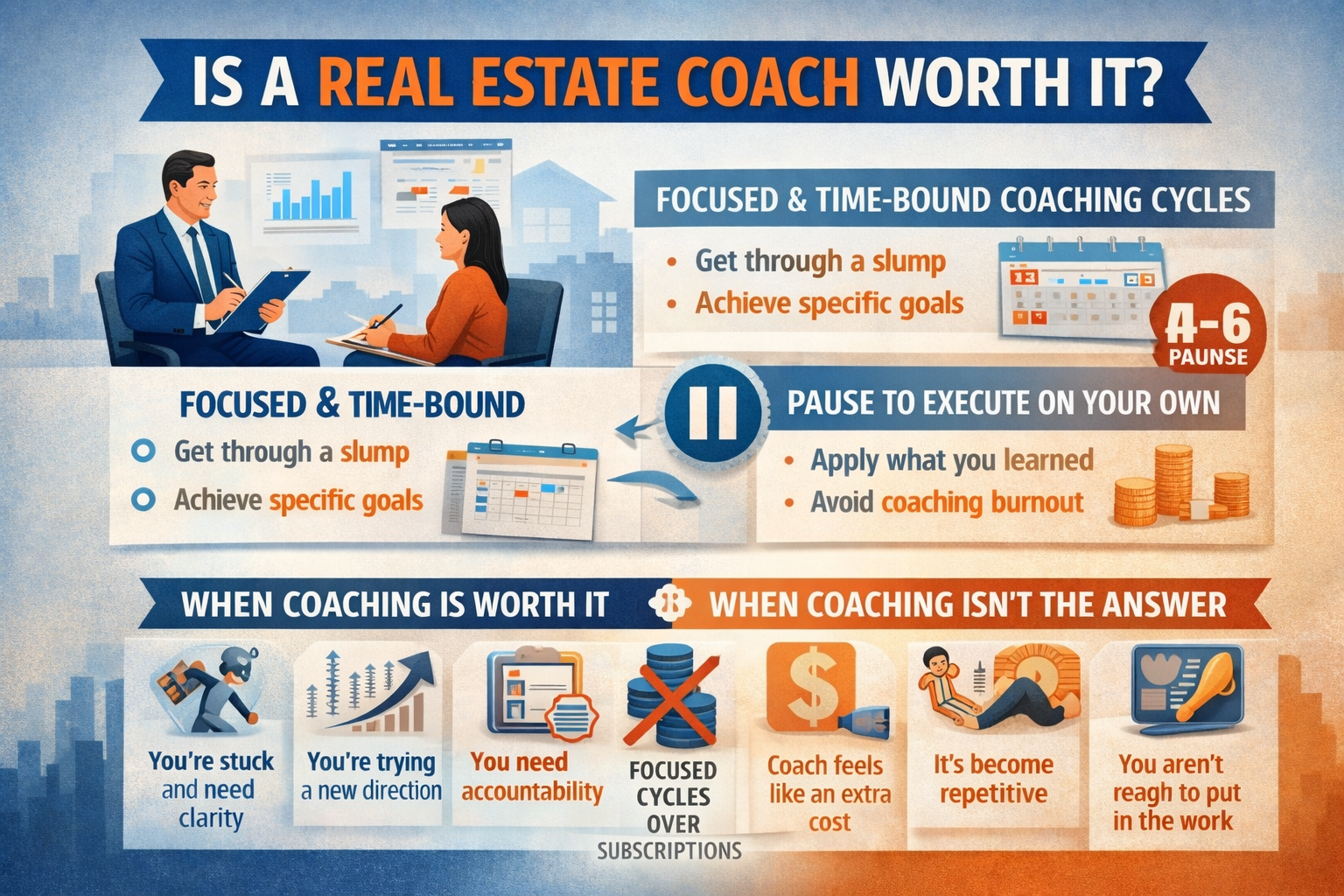
The truth is that coaching is most powerful in concentrated bursts. A focused four to six month engagement — where you're working on something specific, pushing through a defined slump, or developing a particular skill — can create real movement. But at a certain point, the value of coaching shifts. You stop absorbing new insights and start just checking in. And that's when many agents would be better served by putting the coaching on pause and actually executing on what they've learned.
The agents who get the most out of coaching treat it as a tool they pick up and put down strategically — not a subscription that runs in the background indefinitely.
When a Real Estate Coach Is Worth Every Penny
Coaching earns its cost when you're working on something specific and the accountability of an outside perspective is what gets you across the line. Here's when it tends to deliver the most value:
You're in a genuine slump. Not a slow week — a real plateau that's lasted long enough that you know something needs to change but you're too close to the problem to see it clearly. A good coach creates distance from the day-to-day and helps you identify what's actually holding you back.
You're attempting something new. Launching a team, shifting your niche, moving upmarket, building a referral-based business from scratch — these are transitions where having someone who's navigated the territory ahead of you shortens the learning curve significantly.
You need structured accountability. Some agents are self-directed enough to execute on their own plans. Others do their best work when they know someone is going to ask them about it next week. There's no shame in that — knowing which one you are is self-awareness, not weakness.
You're ready to actually do the work. This one matters more than people want to admit. A coach can give you clarity, frameworks, and a plan — but they can't execute for you. If you're not at a point where you're ready to act on what you're learning, the coaching won't stick regardless of how good the coach is.
When Coaching Isn't the Right Answer
Real estate coaches are not right for every agent in every season — and the industry doesn't talk about this enough.
If you're already clear on what you need to do and simply aren't doing it, adding a coaching program to your calendar is unlikely to change that. Accountability only works if you're genuinely ready to be held accountable. More than a few agents have signed up for coaching as a way of feeling like they're taking action — without actually doing the harder work of changing their habits and activities.
There's also a ceiling to what a single coach can offer. Most real estate coaches are teaching a defined system — one that worked for them, or for the people they've coached. They'll customize it for your market and your situation, but the core framework is largely fixed. If you've been with the same coach for a long time, there's a real question worth asking: am I still learning, or am I just being reminded?
That's not a knock on coaches. The good ones are genuinely skilled at what they do. It's just an honest recognition that the return on coaching, like most investments, has a natural diminishing curve.
The Smarter Approach: Cyclical Coaching
The most effective pattern we've seen for agents who use coaching well looks something like this: engage a coach for four to six months with a specific focus, execute hard on what you're learning, then pause the coaching relationship and spend time actually doing the work. When you hit a new ceiling or a new challenge that needs an outside perspective, engage again.
On. Off. On. Off.
This approach keeps the coaching relationship high-value on both sides. You come in with real problems, you get real traction, and you leave when the value has been extracted. Then when you return — whether it's three months or a year later — you come back with fresh challenges and the capacity to absorb new input.
Don't Limit Yourself to Real Estate-Specific Coaching
One thing worth considering that most agents never think about: some of the most valuable coaching comes from outside the real estate industry entirely.
Real estate coaches are experts in real estate. But business is business. Leadership, communication, time management, mindset, team building — these skills don't care what industry you're in, and coaches who work across industries often bring perspectives that a real estate-specific coach simply hasn't encountered. If you've been coaching exclusively within real estate, spending a few months working with a business coach, an executive coach, or even a leadership-focused group from another field can unlock ideas that never would have surfaced inside the industry.
The agents who grow the fastest aren't always the ones consuming the most real estate content. Sometimes they're the ones willing to pull insights from somewhere unexpected.
How CrossView Realty Thinks About Agent Development
At CrossView Realty, we believe investing in your growth as an agent is one of the best decisions you can make — whether that's through coaching, continuing education, peer learning, or simply finding the right brokerage environment that challenges you to keep getting better. Our agents across Jacksonville, St. Augustine, Ponte Vedra Beach, Orange Park, Fleming Island, Nocatee, and NE Florida have access to ongoing training, mentorship, and a culture built around continuous improvement. We're not here to replace a coach — we're here to be the kind of brokerage that makes every investment in your development actually pay off.
The Bottom Line
Is a real estate coach worth it? For the right agent, at the right time, working on the right thing — yes, absolutely. But coaching works best when it's intentional, time-bounded, and followed by a real period of execution. Treat it like a strategic investment with a specific purpose, not an ongoing subscription with a vague goal of "getting better," and the return on that investment gets a lot more predictable.
If you're a real estate agent in Jacksonville or Northeast Florida thinking about how to get to the next level in your career — whether through coaching, a brokerage change, or something else entirely — we'd love to be part of that conversation.
👉 Visit joincrossviewrealty.com or call CrossView Realty at 904-503-0672
Frequently Asked Questions
Q: Is a real estate coach worth it for newer agents? It depends on where you are in your career and what you're working on. For newer agents, the priority is usually execution — learning the basics, building your sphere, and closing your first few deals. A coach can help with that, but only if you're ready to act on what you're learning. If you're still finding your footing, a strong mentorship program at the right brokerage may deliver more practical value in the short term.
Q: How long should you work with a real estate coach? Four to six months is often the sweet spot for a focused coaching engagement. That's enough time to create real change on a specific challenge without overstaying the point of diminishing returns. Many successful agents use coaching in cycles — engaging for a few months, executing independently, then returning when a new challenge emerges.
Q: What should I look for in a real estate coach? Look for someone with a track record of working with agents at your production level and in your market type. Ask whether they're still actively practicing real estate or primarily coaching. Understand what their framework is and whether it fits how you work. And be honest with yourself about whether you're at a point where you're ready to act on what they teach — accountability only works if you're genuinely ready for it.
Q: Are there alternatives to hiring a real estate coach? Yes — and they're worth exploring. Mastermind groups, peer accountability partnerships, brokerage-based mentorship, and outside-industry business coaching are all legitimate alternatives that work well for certain agents. The right growth vehicle depends on where you are, what you need, and how you learn best.
Q: Can you work with a real estate coach and a non-real estate coach at the same time? Absolutely — and many high-performing agents find that combining industry-specific coaching with broader business or leadership coaching gives them perspectives they wouldn't get from staying inside real estate alone. Different lenses on the same challenges can produce insights that neither coach would surface on their own.